


Why NDA matters and why start early for 2026
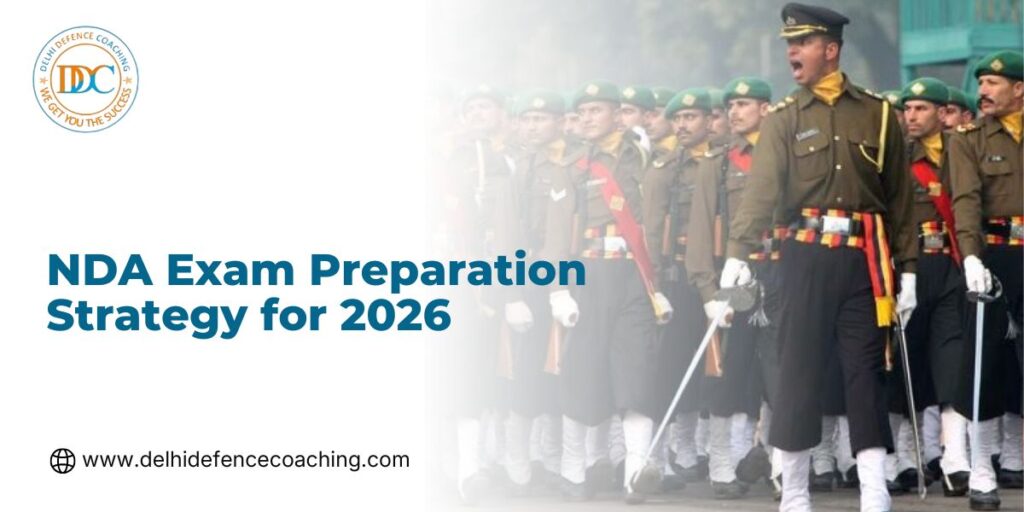
The NDA is the gateway to joining the Indian Armed Forces as an officer cadet through a meritocratic, academically demanding, and psychologically rigorous selection process. For many aspirants, the NDA is the first major competitive exam they face. Success requires a mix of school-level knowledge, problem-solving speed, sustained revision, and personality development, which is why students often research preparation methods, self-study plans, or options such as NDA exam coaching Delhi while planning their journey.
Starting early, especially from Class 11 or Class 12, gives aspirants enough time to build conceptual clarity in Mathematics and English/GK, develop disciplined study habits, and gradually improve physical fitness and mental resilience required for SSB. Early preparation also reduces last-minute pressure and allows aspirants to approach the exam with confidence and maturity.
NDA exam pattern for 2026 (Written + SSB)
The NDA selection process consists of two major stages: the Written Examination conducted by UPSC and the SSB Interview conducted by the Services Selection Board.
Written Examination
The written exam is conducted in objective format and consists of two papers held on the same day:
Paper 1: Mathematics
- Objective type questions
- Duration: 2.5 hours
- Maximum marks: 300
- Based on Class 11 and Class 12 syllabus
- Negative marking applies
Paper 2: General Ability Test (GAT)
- Duration: 2.5 hours
- Maximum marks: 600
- Divided into:
- English (200 marks)
- General Knowledge including Physics, Chemistry, Biology, History, Geography, Polity, and Current Affairs (400 marks)
Total marks for the written exam are 900.
Candidates who clear the written cutoff are shortlisted for the SSB Interview.
SSB Interview
The SSB Interview carries 900 marks and is conducted over 4 to 5 days. It evaluates personality, leadership potential, decision-making ability, and officer-like qualities. The final merit list is prepared by combining written exam marks and SSB performance.
Written exam preparation strategy (Subject-wise)
Mathematics preparation strategy
Mathematics in NDA tests conceptual understanding, accuracy, and speed.
Study approach
- Strengthen fundamentals from Class 11 and 12 topics such as algebra, trigonometry, coordinate geometry, calculus, vectors, matrices, probability, and statistics.
- Follow a topic-wise sequence starting from algebra and trigonometry, then geometry, calculus, and finally vectors and probability.
- Practice daily numerical problems to improve calculation speed.
Key focus areas
- Algebraic equations and inequalities
- Trigonometry identities and applications
- Coordinate geometry and 3D geometry
- Differential and integral calculus basics
- Vector algebra and probability
Time management
- Attempt easy and familiar questions first
- Avoid spending excessive time on one question
- Reserve last 20 to 30 minutes for revision
Common mistakes
- Ignoring basic formula revision
- Making careless calculation errors
- Over-attempting despite negative marking
General Ability Test (GAT) preparation strategy
English section
- Read daily to improve comprehension and vocabulary
- Practice grammar rules, error spotting, and sentence improvement
- Solve comprehension passages under timed conditions
General Knowledge section
- Revise Physics, Chemistry, and Biology fundamentals from NCERT level
- Study Indian history, geography, polity, and economics systematically
- Follow current affairs daily with focus on national, international, and defence-related news
Exam tips
- Attempt high-confidence questions first
- Avoid blind guessing due to negative marking
Daily and weekly study plan framework
Daily study routine (6 to 8 hours)
- Morning: Physical training and light revision
- Study Session 1: Mathematics concept and practice
- Study Session 2: GAT subject or English practice
- Evening: Current affairs reading and revision
- Night: Formula revision and next-day planning
Weekly plan
- Weekdays: Topic-wise coverage
- Saturday: Sectional tests and error analysis
- Sunday: Full revision, light study, and physical training
Monthly full-length mock tests help track progress and improve exam temperament.
SSB Interview process explained
The SSB Interview is designed to assess Officer Like Qualities (OLQs).
Screening Test (Day 1)
Officer Intelligence Rating (verbal and non-verbal reasoning)
- Picture Perception and Discussion Test (PPDT)
- Only screened-in candidates proceed further.
Psychological Tests
- Thematic Apperception Test (TAT)
- Word Association Test (WAT)
- Situation Reaction Test (SRT)
These tests evaluate personality traits, thought process, and emotional stability.
GTO Tasks
- Group discussions
- Group planning exercise
- Progressive and half group tasks
- Individual obstacles
- Command task
- Lecturette and final group task
Personal Interview and Conference
- Personal interview assesses background, motivation, and awareness
- Conference finalizes recommendation based on overall performance
SSB preparation strategy
Personality development
- Understand OLQs and practice them in daily life
- Develop leadership, responsibility, and initiative through real activities
Communication skills
- Practice speaking clearly and confidently
- Participate in group discussions and debates
Psychological test practice
- Write spontaneous and positive responses
- Focus on practical problem-solving and optimism
Current affairs awareness
- Read newspapers daily
- Stay informed about defence, national, and international issues
Mock SSB practice
- Regular mock interviews and group tasks improve confidence
Physical fitness and mental discipline
Physical fitness
- Regular running (3 to 5 km)
- Bodyweight exercises such as push-ups, squats, pull-ups
- Flexibility and balance training
Mental discipline
- Maintain a consistent routine
- Practice meditation or breathing exercises
- Ensure proper sleep and nutrition
Consistency is more important than intensity.
Preparation resources
- NCERT textbooks for conceptual clarity
- Topic-wise practice question sets
- Full-length mock tests under exam conditions
- SSB preparation guides focusing on psychology and GTO tasks
Many aspirants explore options like NDA exam coaching Delhi or search for the best NDA coaching in Delhi mainly for structured mock tests and SSB exposure. Such resources should be used only as supplementary support, not as a substitute for self-study.
Frequently Asked Questions (FAQs)
1. When should I start preparing for the NDA Exam 2026?
Ideally, aspirants should start preparing at least one to two years before the NDA 2026 attempt. Students in Class 11 or early Class 12 have enough time to build strong fundamentals in Mathematics and General Ability while also developing physical fitness and communication skills required for the SSB Interview.
2. Is the NDA exam syllabus difficult for average students?
The NDA syllabus is based largely on Class 11 and Class 12 academic concepts. It is not overly difficult, but it requires strong conceptual clarity, regular practice, and time management. Consistency matters more than prior academic excellence.
3. How many hours should I study daily for NDA preparation?
On average, 5 to 7 focused study hours per day are sufficient for NDA preparation if followed consistently. This should include academics, physical training, current affairs reading, and revision. Quality of study is more important than long study hours.
4. Can I clear NDA without coaching?
Yes, many candidates clear the NDA written exam and SSB through self-study. Coaching can help with structured mock tests and SSB practice, but success mainly depends on disciplined self-study, regular revision, and honest self-assessment. Some aspirants still explore options like NDA exam coaching Delhi mainly for mock exposure.
5. How important is Mathematics in the NDA written exam?
Mathematics is crucial because candidates must clear the Mathematics cutoff separately. Strong performance in Mathematics also reduces pressure on the GAT paper. Regular problem-solving and formula revision are essential to score well.
6. What qualities does SSB look for in NDA candidates?
The SSB looks for Officer Like Qualities such as leadership, effective communication, decision-making ability, responsibility, teamwork, and emotional stability. These qualities are assessed through psychological tests, group tasks, interviews, and overall conduct during the SSB process.
7. How can parents support NDA aspirants during preparation?
Parents can support aspirants by encouraging a disciplined routine, understanding the demands of NDA preparation, avoiding unnecessary pressure, and supporting physical fitness and mental well-being. A positive home environment helps aspirants stay focused and motivated throughout the preparation journey.
Conclusion
Preparing for the NDA Exam 2026 requires disciplined academics, strong fundamentals, physical fitness, and balanced personality development. The written exam and SSB are not separate challenges but connected stages of the same journey, a perspective consistently emphasized in structured guidance frameworks followed by institutions like Delhi Defence Coaching while mentoring defence aspirants.
Focus on consistency, clarity, and character building. With early planning, structured preparation, and a calm mindset, NDA aspirants can approach the exam with confidence and purpose, regardless of whether they prepare independently or with academic guidance support.

